Endometriosis Bowel Symptoms
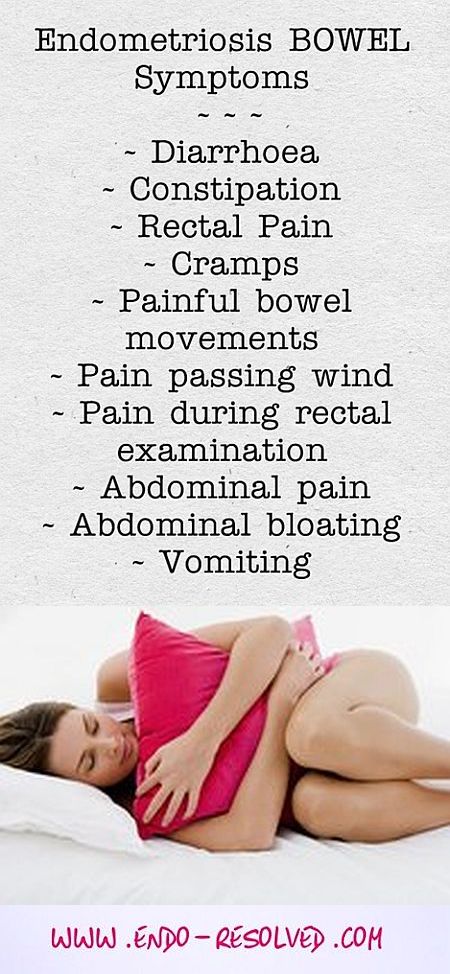
Many women suffer with a range of distressing symptoms of the bowel caused by endometriosis.
However, too many doctors still do not think of endometriosis when their patients report symptoms such as intermittent constipation or diarrhoea, or alternating bouts of the two or bleeding from the rectum.
Most importantly, they do not think to ask woman if their bowel symptoms vary with their menstrual cycle – the key feature of bowel involvement due to endometriosis. As a result, some young women are not being diagnosed.
Causes of Bowel Endometriosis
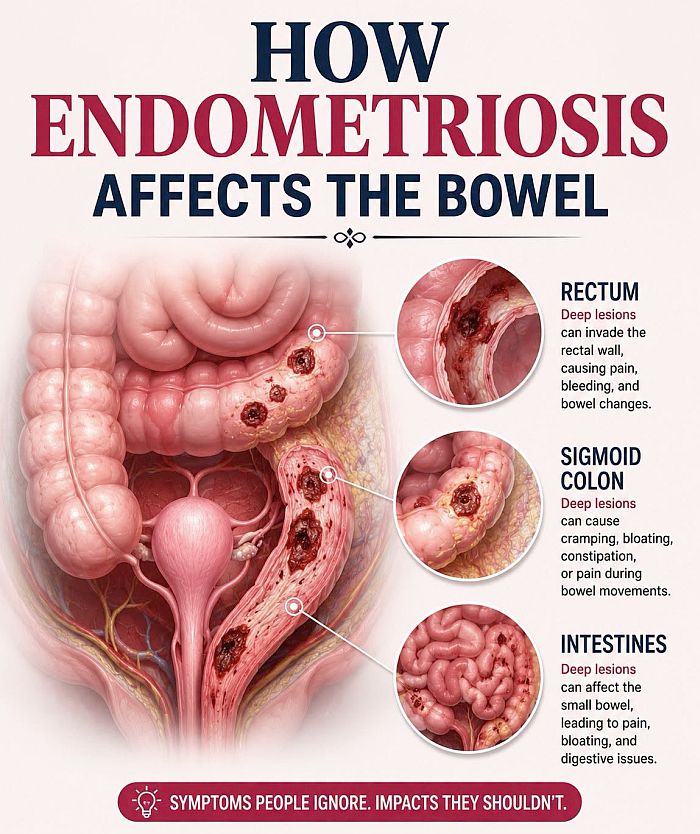
Most bowel symptoms are not due to the presence of endometriosis on the surface of the bowel itself. Rather, they are usually due to irritation from implants and nodules located in adjacent areas, such as the Pouch of Douglas, uterosacral ligaments, and recto-vaginal septum.
In those cases where the endometrial implants are located on the bowel, the implants are usually lying on the outside surface of the rectum rather than in the bowel itself. Nevertheless, endometriosis can penetrate into and through the bowel wall on some occasions.
The large bowel is a much more common site of endometriosis than the small bowel. Some symptoms are due to adhesions constricting, twisting, or pulling on the bowel.
How common is it?
Studies suggest that bowel endometriosis estimates vary quite a lot because it is
hard to detect. There may be ranges from about five percent up to a third of women suffer from endometriosis of the bowel. These figures depend on the quality of the study and how carefully doctors look for the disease and their level of
expertise in treating endometriosis.
90% of bowel endometriosis cases involve the rectum and large intestine
Symptoms often look like IBS
Painful bowel movements, bloating, constipation or diarrhea that increase around periods, and sometimes rectal bleeding with periods. Deep pelvic pain with sex can be another clue when the rectovaginal area is involved.
Because these signs cross over with gut problems, many women get sent down a GI path first. Scans can come back as normal, that is unless you have an experience surgeon who will recognise the pattern of symptoms.
Diagnosis of Bowel Endometriosis
Bowel endometriosis is difficult to diagnose due to the location of the disease and the inability of imaging tests to locate the disease.
Initial diagnosis relies a great deal on the woman's description of her symptoms and menstrual history. Bowel symptoms due to endometriosis are generally only present or worse around the time of the period, though they may be present throughout the month for some women.
They are also usually reported along with one or more of the classical symptoms of endometriosis, such as painful periods and painful intercourse, rather than on their own.
A gynaecologist may refer their patient to a Gastro-Intestinal specialist if he or she is not sure whether the bowel symptoms are due to endometriosis or another cause.
Occasionally, the gynaecologist may refer the woman to a specialist for a colonoscopy. A colonoscopy is an examination of the inside of the gastro-intestinal tract with a telescope-like instrument. In most women with endometriosis, the colonoscopy will be normal because endometrial implants and nodules rarely penetrate through the wall of the bowel wall so they are not visible during a colonoscopy.
In order to formally diagnose and treat bowel endometriosis, laparoscopic surgery must be performed
Diagnostic options may include:
- Vaginal examination
- Ultrasound
- Sigmoidoscopy and/or Laparoscopy - operations to look inside your bowel and abdomen respectively
- CT and/or MRI scan – if deep endometriosis is suspected
Treatment for Bowel Endometriosis
Endometrial nodules in the Pouch of Douglas, uterosacral ligaments, and recto-vaginal septum are generally larger and deeper than ordinary implants. They do not usually respond to drug treatment so they will usually be removed surgically.
Bowel endometriosis surgery is usually performed as a team effort by a specialist gynaecologist (expert in advanced laparoscopic excision of endometriosis) and a specialist colorectal surgeon (bowel surgeon). Because they are difficult to reach, there is a danger that the bowel may be damaged accidentally during surgery. Therefore, the surgeon must be experienced at laparoscopic surgery.
Cutting (excision) or shaving techniques are usually used to remove the disease. Superficial endometrial implants on the surface of the bowel are usually removed by carefully removing the relevant part of the membrane that covers the bowel wall.
If the endometriosis has penetrated through a section of the bowel wall, that section of the bowel may have to be removed. Few gynaecologists are able to perform this surgery, and as mentioned above, a bowel surgeon will be called in to perform the resection.
How serious is Bowel Endometriosis?
Bowel endometriosis is generally not life-threatening, but in some cases it can be serious causing very painful symptoms. Deeply infiltrating lesions can grow thick and cause severe narrowing or partial blockage of the bowel. This can lead to constipation, diarrhea. and boating. Complete bowel obstruction or a tear in the bowel wall are considered to be very rare, but they are dangerous emergencies.
The first signs of bowel endometriosis usually include painful bowel movements during periods, cyclical bloating or "endo belly," and alternating constipation or diarrhea that worsen significantly during menstruation. As you can see, there is a common cross-over with some of the symptoms of endometriosis, but pain in bowel is a good indicator that the bowel may be involved.
If your symptoms have changed or worsened you need to get this checked out with your doctor. Leaving bowel endometriosis untreated will only get worse with worsening scar tissue and could possibly lead to a blockage.
You might like these
Personal Experience Self-Treating Endometriosis Cysts
The main driver for the development of endometriosis cysts is excess estrogen – here is one woman’s experience of using natural methods to stop them developing.
Endometriosis and the SIBO connection
Recent research shows that 92% of endometriosis patients with digestive issues test positive for SIBO which could be the cause of your endo belly
Endometriosis and Leaky Gut Syndrome
There appears to be a link between endometriosis and Leaky Gut Syndrome which has been found to affect 45% of women with the disease and Leaky Gut can compromise the immune system
Endometriosis Adhesions
A description of adhesions and how they are caused by the disease or by post operative scarring
Managing an endometriosis flare
Endometriosis commonly causes painful flares where symptoms become much worse. Here we look at some of the triggers and self-help measures you can use




Who is behind this site . . . .
Hi, I’m Carolyn Levett, an endometriosis author, mentor, Integrative Health Coach and fellow endo warrior.
Having experienced endometriosis myself, I found my way towards better health through nutrition, natural remedies and support. I’m the bestselling author of 'Recipes & Diet Advice for Endometriosis' and 'Endometriosis – Healing from the Inside Out', and hold qualifications in nutrition, naturopathy and women’s hormone health.
I know how isolating and overwhelming endometriosis can be, especially when you feel unheard or your symptoms aren’t taken seriously. My aim is to share the knowledge, practical advice and support I wish I’d had, helping other women feel more informed, empowered and able to manage their endometriosis more naturally.
You don’t have to navigate endometriosis alone.
Reference:
https://www.endometriosis-uk.org/endometriosis-and-bowel
https://www.ncbi.nlm.nih.gov/pmc/articles/PMC4229526/
https://www.everydayhealth.com/endometriosis/bowel-endometriosis/
 As featured in:


About Endo Blog Contact Disclaimer Site Map Privacy Policy
Carolyn Levett BA, NT Nutritional Therapist -
Promoting health and well-being through nutrition, diet and lifestyle changes
The material on this website is intended for educational information purposes only.
It should not substitute or delay medical advice, diagnosis or treatment.
Unauthorized use of content or parts of content is prohibited without a written permission by the author.
www.endo-resolved.com Copyright (C) - All rights reserved 2026