Laparoscopy TIPS for endometriosis
How to prepare for your surgery with tips to help speed your recovery
For many going into hospital for the first time to have a Laparoscopy can be a worrying time. The emotional anxiety about what the surgeon will find will cause as much concern as the actual process of having an operation. I have put together here a list of tips, ideas and advice to help you get prepared for your laparoscopy and how to help your recovery
Preparing for laparoscopy
If you are well prepared the whole experience will be less traumatic and frightening. It is also vital to obtain information from your consultant or gynaecologist as to what they intend to achieve during your laparoscopy.
If you are unclear of anything they say, ask for a better explanation. You will no doubt have many questions and concerns. Write these down and discuss them in your pre-op appointment with your consultant.
You will want to know what surgical options there are for the treatment of Endometriosis. This will depend on the training and experience of your particular consultant. You will also want to know how your consultant can deal with different stages of the disease. Each laparoscopy will be different as no two women are the same, and there are no set patterns to this disease.
If you are member of an Endometriosis support group in your area, talk to other women in the group of their experiences and what they did that helped when they had a laparoscopy.
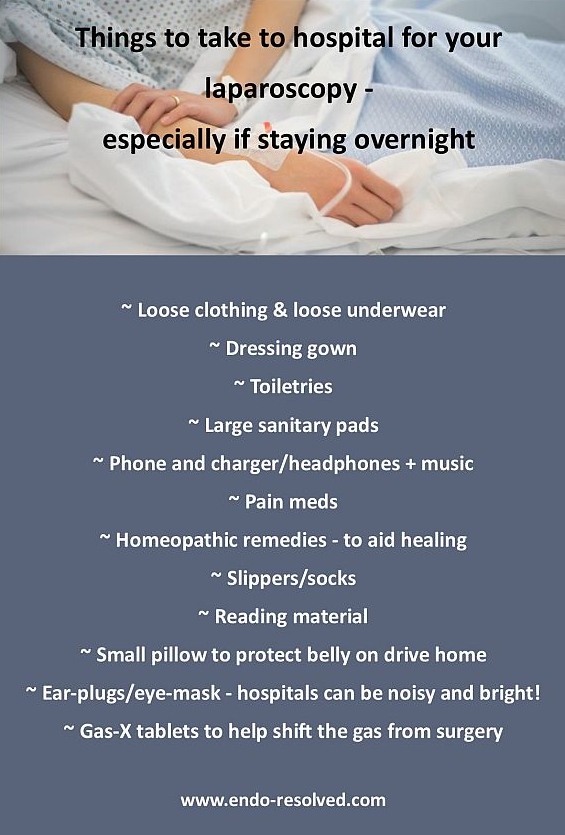
Prepare Practicalities
There are many small but very useful things you can do to make the whole process of undergoing surgery and recovery much easier. Much of this is about preparing things around the home so that you can focus on resting and recovery when you get back home.
- Prepare your food stocks so that you have all the provisions you will need. If you live with a partner then they will be doing the cooking, but if you live alone you need to buy in some frozen or instant meals. Better still, cook and freeze your own meals in advance.
- Clean your home the day before surgery, then you come home to a nice environment
- Change the linen on your bed the day before surgery, again for the pleasure of nice clean sheets, and you will not be capable for changing the linen for at least a week by yourself
- Make sure you have a supply of sanitary towels, pain killers, hot water bottle, make sure you have some reading material and that your Netflix account is up to date
- Ensure you have 2 or 3 loose fitting outfits clean and read. You will not want to be wearing anything tight, especially round the abdomen
- Start taking extra Vitamin C for about 2 weeks prior to the operation - this will help your body deal with the anaesthetic as well as help with healing
- Purchase Homeopathic Remedies - Arnica 30c - you will use this to assist healing and relieve pain after surgery. Phosphorus 6c - to relieve vomiting after anaesthetic
- Purchase some throat lozenges - to help with the sore throat caused by the tube which is put down your throat during the operation
- Inform friends and family of your operation date and the time you expect to be back home. This will allow them the opportunity to keep in touch and see how you are. Also put your phone by the bed for easy reach.
- Obviously if you have children you will have to make child care arrangements. If you have pets, especially a dog, you need to make arrangements for dog walking
Prepare Yourself
- The day before - eat light and healthy and drink lots of fluids. Do not eat or drink anything after 12.00 midnight the night before surgery. Do not smoke or chew gum after 12.00 midnight If your surgery is scheduled for later in the day, it is advised to have some supper around 11.00pm so you are not totally starving throughout the next day
- Your doctor or consultant will probably ask you to do an enema in the evening to clean out your bowel. If more severe Endometriosis is suspected, then a full bowel prep may be required. You will be given instructions on this during your pre-op office visit. Preparing the bowel with a purging agent such as Magnesium Citrate is often followed by an oral antibiotic and enemas. While unpleasant, this procedure minimises the risk of surgical complications from bowel injury during surgery.
- Pack a hospital bag including: warm, loose clothing to wear after the operation, wash-kit, phone - should you need to contact someone, sanitary towels, something to read if you have to wait around for your turn in theatre, clean socks to keep your feet warm during surgery. Leave your wallet and valuables at home.
- Remove all nail polish, remove jewellery and contact lenses
- Ensure that you have a lift home from hospital. If this has been prearrange with a friend some time beforehand, ring them a few days before to ensure they remember.
- Take a long warm bath the night before, drink some chamomile tea to aid restful sleep, and get a good nights sleep
The day of surgery
- Try to get up early, take a shower if you wish and put on comfortable clothing. Do not bother doing much to your hair, it will only be put into a protective cap for the operation. Do not forget that you are not allowed breakfast. Do not wear any make-up, perfume, hair spray or deodorant.
- Arrive at the hospital at the designated time to register. There will be forms to fill in and consent forms to sign. Ensure that you specify what you do NOT want to have done during surgery.
- The process of signing in to hospital on the day of your treatment, will vary for different countries, but the actual medical procedure will be similar. You will probably be shown to your bed and given instructions by a member of the ward staff. This usually involves instructions for getting undressed and changed into hospital gowns, putting any belongings into safe keeping, and then advised to wait for consultations with the medical staff. You will get a visit from your consultant and one from the anaesthesiologist.
- You need to discuss with the anaesthesiologist any fears or worries you have. They will ask you about any allergies you may have or whether there is any family history of bad reaction to anaesthesia.
- Depending which country you are having treatment, you will probably be given a pre-op shot which makes you feel very drowsy and floaty. This helps to alleviate some of the nervousness. This is usually given about an hour before the operation.
- When it is time to go to theatre for your surgery, you will be collected. In the UK this is done by porters who put you on a trolley, cover you in blankets to keep you warm and you are wheeled off down endless corridors in a drowsy state.
- You will arrive at the theatre suite, in a prep room just outside of theatre. The anaesthesiologist will make sure you are ready and will then insert an IV (intra-venous) needle into the back of your hand. A tube is then fitted to the IV ready for the anaesthetic to flow directly into your system. The anaesthesiologist will ask you to start counting backwards from 100, keeping your eyes open. You will feel a cold rush into the back of your hand as the anaesthetic starts to flow into your system. Most people do not get much further than counting down to about 8.
Surgical Recovery
You will not remember anything else until after your operation. Depending on which country you live in, you will either come round from the surgery in the recovery room or you will back on the ward in your bed.
You will be feeling very groggy and unsure of where you are at first. You will then begin to focus your thoughts for a while and will realise that you are back safe in the real world again. You will drift in and out of sleep for a few hours whilst the aesthetic wears off. A nurse should come and take your temperature and check your pulse and blood pressure at regular intervals.
As you begin to come round a bit more you will start to feel the different pains in your body. You will have pain where the incisions were made, your abdomen will feel sore and painful from the operation as well as being distended by the gas. The worse pain noted by most women is a sharp stabbing pain in the shoulder.
This is a side-effect of the gas that is used to distend the abdomen, which seems to travel around the system. The pain can feel as though a sword has been driven through you. So watch out for this one.
You need to ask for pain killers if you suffering a lot. You can also be given something to help with the nausea. You need to try sipping some water if you feel up to it. Many people feel too nauseous to let anything pass there lips.
This is a good time to take some Phosphorus - the Homeopathic remedy - to help you stop feeling so queezy. Take one dose every half hour until you start to feel more settled. You can then start to get some fluid into your system and drink some water. You also need to start taking some Arnica - the other Homeopathic remedy - to help speed up recovery and reduce the pain.
You will find yourself continuing to drift in and out of sleep very easily for a few more hours. Do try to get up at some point and go to the toilet to urinate. This will sting because of the catheter that is inserted for the operation. If you are having treatment on a day-care basis you will not be allowed to go home until you have urinated. This is to ensure that your system is working correctly.
If you staying at the hospital overnight then you will be given something very light to eat before the day is over. This will help to level out your blood-sugar levels and will improve how you feel.
Your first night will be rather uncomfortable with abdominal pain, feeling groggy from the operation, and an awful shifting pain in your shoulders, which hurts every time you move around. The pain is at its worse when you try to sit up. Do your best to lie still for your first night, and try not to get to distressed about the results of your surgery.
You may have been given your results on the day of the operation but in most cases your consultant will inform you of the outcome the following day if you are staying overnight.
If you are a day-case, you can go home once you feel ready for the journey and the medical staff are happy with your vital signs. Those who are staying over-night will be checked over in the morning and will probably go home around mid-morning.
For your journey home, ensure someone is going to collect you. You will NOT be able to drive yourself. It is a good idea to have a small cushion to hold against your abdomen. This helps to protect you from sudden bumps in the road. It is also advisable and more comfortable to recline your seat slightly.
Get out of the car carefully AND GO TO BED.
Recovery at home
For the first few days you need to stay in bed and get as much sleep as possible. You will have bleeding which will be similar to having a period, which is normal.
- The incision near the navel can be rather sore. If you have had another incision lower on the abdomen this will also need protecting. Do not wear any clothing that is going to rub on these incisions. Follow your doctors instructions on cleaning and dressing the incisions and watch for signs of infection.
- The stitches used in the incisions are usually the type that dissolve so you do not need to return to hospital to have them removed
- It can take a few days for the shoulder pains caused by the gas to finally stop. It will also make you belch a lot.
- Your abdomen will be bloated for a few days, but will gradually go down
- The amount of surgical pain and cramping you have depends on how extensive your surgery was. Use painkillers and a hot water bottle or heating pad.
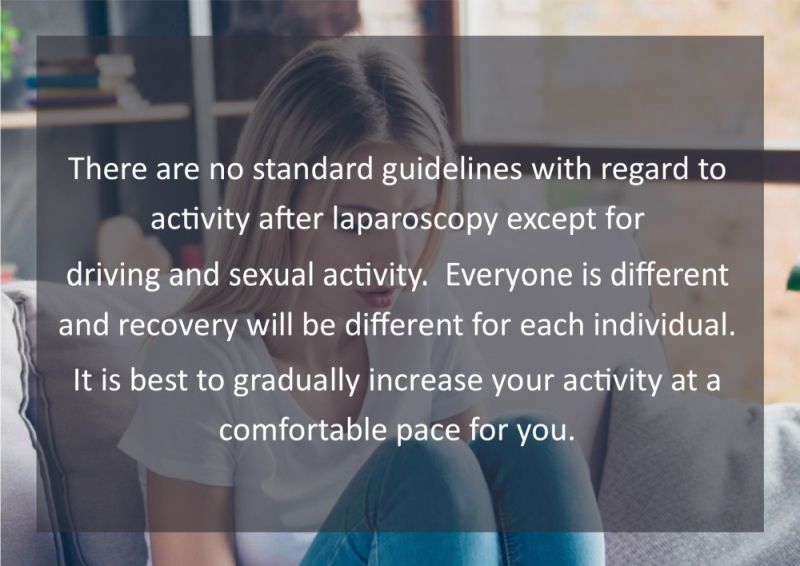
- Just take things steady for the first few days. Try to get up and walk around the house a little bit. You may feel dizzy and weak, but it is better that lying in bed and not moving at all, which will make you feel worse when you do try to get up.
- Your diet needs to be very light and simple for the first few day. You may find that you are constipated which is caused by a combination of the anaesthetic, lack of bodily movement, lack of food intake, and the effects of painkillers.
- Drink lots of fluids, especially pure water, fruit juices, herb teas. Increase you bulk intake after 2 days. It is best not to eat too much at first. Digestion taxes the system and requires energy for digestion to take place. It is best to reserve this energy for healing and let your body get over the shock.
- Gradually get back into normal routine over a period of about a week, increasing what you do every day.
- Do not try to bend over to pick things up - it hurts far too much. Bend at the knees instead and drop your weight down to pick things up.
- Continue taking a few doses of Arnica each day to help speed your recover
Returning to daily life
Your healing will be steady and gradual over the period of about 2 weeks before you start to feel somewhat normal again. I would not personally advise going back to work for a least a week, and this is only if you do a desk job. If you do any physical work - which most women with endometriosis cannot anyway - but you need to consider having at least 3 weeks off work.
You can read further tips and feedback from one reader and her experience of laparoscopy surgery for endometriosis HERE
You might like these
Natural Endometriosis Treatment Articles
A collection of great articles covering different aspects of using natural treatments to help with endometriosis
Natural pain treatments for endometriosis
There are many natural supplements you can use to help with the pain of endometriosis
Aloe vera juice benefits for endometriosis
To support the body cope with endometriosis aloe vera juice is packed with nutrients and helps support the immune system and heal the gut
Endometriosis - Just how effective are natural treatments?
There are many natural treatments you can use for endometriosis, a look at how good they are at helping with the pain and symptoms
Natural remedies for support while managing endometriosis
Use natural safe remedies to support your body, help with stress, pain and inflammation and support your immune system when dealing with endometriosis







 As featured in:
About Endo Blog Contact Disclaimer Site Map Privacy Policy Affiliate
Carolyn Levett BA, NT Nutritional Therapist -
Promoting health and well-being through nutrition, diet and lifestyle changes
The material on this website is intended for educational information purposes only.
It should not substitute or delay medical advice, diagnosis or treatment.
Unauthorized use of content or parts of content is prohibited without a written permission by the author.
www.endo-resolved.com Copyright (C) - All rights reserved 2025